
Mental wellbeing is influenced by more than what happens inside the home. The surroundings in which people spend their everyday lives can also shape how they rest, move, socialise and recover from demanding routines.
This is one reason the benefits of living close to nature have become increasingly relevant to people considering where and how they want to live. Green surroundings can provide opportunities to spend time outdoors, walk, pause and disconnect from the constant stimulation of urban environments.
Research does suggest a positive relationship between access to green and blue spaces and mental health, although the strength of evidence varies across different outcomes and types of exposure.
For families considering a second home, this makes the setting worth examining alongside the home itself. In a natural destination such as Karjat, the landscape can become part of the lifestyle rather than something experienced only during an occasional outing.
Quick Answer: How Can Living Close to Nature Support Mental Wellbeing?
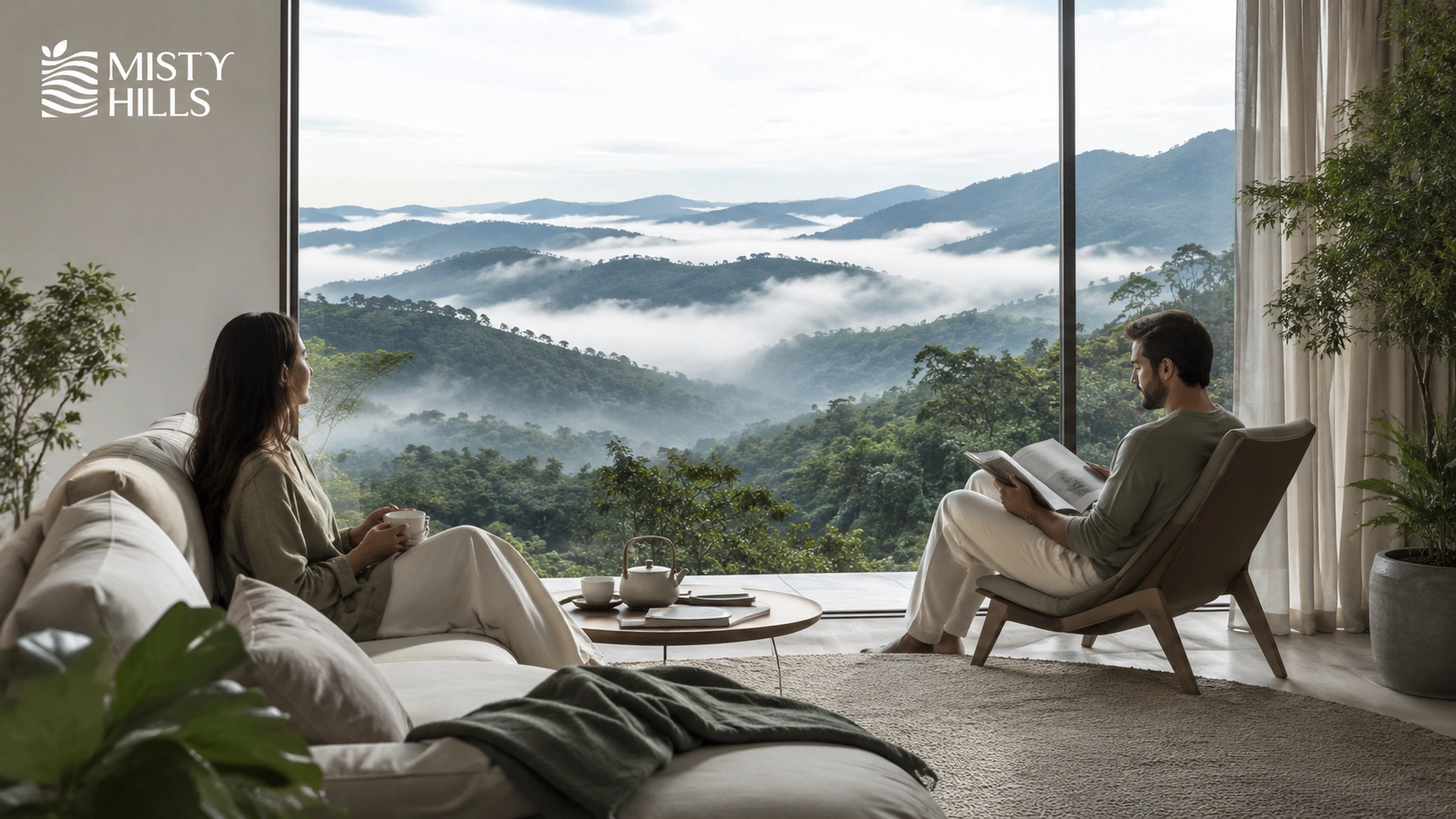
The benefits of living close to nature can include more opportunities for outdoor activity, relaxation, social interaction and psychological restoration. Research has found associations between access to green spaces and improved aspects of mental wellbeing, while nature-based outdoor activities have also been associated with improvements in mood and anxiety in adults.
For a homebuyer, however, living near nature does not automatically guarantee better mental health. The quality, accessibility and actual use of the surrounding environment matter. A home that makes it easy to spend meaningful time outdoors can make nature a more regular part of daily life.
Why Nature Can Make a Difference to Everyday Mental Wellbeing
Urban living offers convenience, but it can also involve traffic, noise, crowded spaces, long commutes and highly structured routines. Having access to natural surroundings creates another option for how time is spent.
A systematic review of research on objectively measured green space found that pathways connecting green space with mental wellbeing included psychological restoration, physical activity and reduced perceived stress, although evidence for some pathways remains mixed.
In practical terms, nature can support wellbeing by creating opportunities to:
- Take a walk without needing to travel far
- Spend time outdoors between work and family commitments
- Engage in light physical activity
- Sit quietly or read in an open setting
- Spend unstructured time with family
- Take breaks from screens and indoor environments
These are relatively simple activities. Their value lies partly in making them easier to incorporate into a routine.
The Benefits of Living Close to Nature Go Beyond a Scenic View
A mountain view from a window can certainly add to the appeal of a home, but the more meaningful question is whether residents can actually interact with the surrounding environment.
There is a difference between seeing greenery and having convenient access to it.
Luxury homes surrounded by nature can support a nature-oriented lifestyle when their design, open spaces and surroundings encourage residents to spend time outdoors. Walking paths, gardens, private outdoor areas, views, recreational spaces and proximity to natural landscapes can all influence how frequently people engage with the environment.
Research on nature-based outdoor activities has found evidence of improvements in depressive mood, anxiety and positive affect among adults, particularly through activities such as green exercise, gardening and nature-based therapy.
This does not mean a home surrounded by greenery is a treatment for mental health conditions. Rather, it can provide an environment that makes certain healthy and restorative behaviours easier to practise.
Why Nature Matters for Families Choosing a Second Home
For families, the value of nature can extend beyond individual relaxation.
Children may have more opportunities to play outdoors, explore their surroundings and participate in physical activities. Parents can spend time with them away from familiar city routines. Older family members may also appreciate quieter surroundings and opportunities for gentle outdoor activity, depending on their individual needs and mobility.
A second home can therefore become more than an occasional holiday property when the setting encourages the family to use it regularly.
This is particularly relevant when evaluating wellness-focused luxury homes. Wellness does not need to mean a dedicated spa or a large list of facilities. It can also involve the basic conditions that support healthier routines: fresh-air exposure, outdoor movement, quiet spaces, family interaction and opportunities to slow down.
Why Karjat Works for Nature-Oriented Second-Home Living
Karjat is relevant to this lifestyle because it combines a natural setting with access to nearby urban centres.
Misty Hills is located in Jambrung, Karjat, Raigarh, Maharashtra. Its current project information places the development 28 km from Karjat Railway Station, 26 km from Neral Railway Station and 63 km from Navi Mumbai Airport.
The development covers more than 15 acres, with the official project information describing 50%+ open green spaces and 360-degree nature and hill views.
For second-home buyers, this combination is relevant because nature becomes part of the immediate residential environment, while accessibility still matters for regular weekend and longer stays.
What Should You Look for in a Nature-Oriented Second Home?
The phrase luxury homes surrounded by nature can mean different things from one property to another. Before making a decision, it helps to examine what "surrounded by nature" actually means on site.
Consider:
Open space: Look at how much of the development is genuinely open and how it is planned.
Views and orientation: Check whether the home has meaningful views and whether they are likely to remain part of the experience.
Outdoor usability: Consider private outdoor areas as well as common spaces that encourage residents to spend time outside.
Accessibility: A natural location needs to be practical enough for the family to visit regularly.
Infrastructure: Water, electricity, security, connectivity and maintenance remain important even in a nature-oriented setting.
Actual lifestyle: Think about what you and your family would realistically do there rather than choosing a property based only on photographs.
A site visit can be particularly useful for understanding the relationship between the residences, open spaces, roads, surrounding landscape and neighbouring properties.
How Misty Hills Connects Nature With Residential Living
Misty Hills is planned as a 15+ acre gated township in Karjat, bringing together private villas, studio apartments and an upcoming 4-star resort by The Fern Hotels & Resorts. The project features more than 50% open green spaces and 360-degree nature and hill views.
The villa component consists of 16 duplex residences, each described as having a private pool and 360-degree mountain views. The project also highlights nature walks, private outdoor living, family weekends, community living, wellness and resort access as aspects of its villa lifestyle.
These features are relevant to the discussion around wellness-focused luxury homes because the approach goes beyond adding wellness as a standalone facility. The surrounding landscape and opportunities for outdoor living form part of the residential experience.
Life at Misty Hills: Making Nature Part of the Everyday Experience
The benefits of living close to nature become easier to understand when nature is available as part of ordinary routines rather than reserved for a holiday.
At Misty Hills, a family weekend could involve starting the morning with mountain views, spending time in private outdoor areas, taking a nature walk and using community or recreational spaces. The villa lifestyle information specifically mentions morning mountain views, private outdoor living, nature walks, family weekends, work from nature and wellness.
The idea is not that every resident will follow the same routine. Instead, the setting provides more opportunities to choose outdoor and slower-paced activities.
The planned Fern resort within the township is also described as a 4-star retreat with a nature, wellness and leisure focus.
For families, that can make a second home feel less like another enclosed property and more like a setting where different routines are possible.
Is Living Near Nature Enough to Improve Mental Wellbeing?
Not by itself.
The evidence supports a positive relationship between nature exposure and several aspects of wellbeing, but research also shows that outcomes vary depending on the type, quality and amount of exposure. The WHO notes an overall positive relationship between green and blue spaces and mental health while also emphasising that there is no single type of natural space that works best for everyone.
This distinction matters when choosing a home.
A property should not be presented as a solution to stress, anxiety or other mental health concerns. Instead, a nature-oriented home can provide an environment that makes outdoor activity, relaxation, social connection and restorative time more accessible.
That is a more realistic way to understand the benefits of living close to nature.
Living Close to Nature as a Lifestyle Choice
The benefits of living close to nature are best understood through everyday experiences rather than promises. A natural setting can create more opportunities to walk, spend time outdoors, connect with family and step away from highly structured routines.
For second-home buyers, this makes the surrounding environment an important part of the decision. At Misty Hills, the Karjat setting, open green spaces, hill views, private villas and a nature-oriented lifestyle are designed around this relationship between home and surroundings.
Ultimately, choosing a home closer to nature is less about expecting nature to solve every wellbeing concern and more about creating an environment that supports the way you want to live.
Frequently Asked Questions
Q1. What are the benefits of living close to nature?
The benefits of living close to nature can include more opportunities for outdoor activity, relaxation, psychological restoration and social interaction. Research has found positive associations between green-space exposure and several aspects of mental wellbeing, although outcomes vary by person and type of exposure.
Q2. Can living near nature reduce stress?
Access to green spaces has been associated with lower perceived stress in research, and nature-based activities have also shown benefits for mood and anxiety. However, living near nature should be viewed as one supportive environmental factor rather than a guaranteed solution for stress.
Q3. What makes a home wellness-focused?
Wellness-focused luxury homes can support healthier routines through access to nature, outdoor spaces, recreational opportunities, quiet areas and comfortable living environments. Wellness is broader than dedicated spa or fitness facilities.
Q4. Is Karjat suitable for a nature-oriented second home?
Karjat can appeal to buyers looking for a second home in a natural setting while retaining access to nearby transport connections. Misty Hills is located in Jambrung, with the project listing 28 km from Karjat Railway Station and 26 km from Neral Railway Station.
Q5. Does Misty Hills offer nature-focused living?
A. Misty Hills is positioned around nature-oriented residential living, with 15+ acres, 50%+ open green spaces, 360-degree nature and hill views, private villas and nature-focused lifestyle experiences including nature walks and private outdoor living.
Comments (0)
Be the first to comment.
Leave a comment